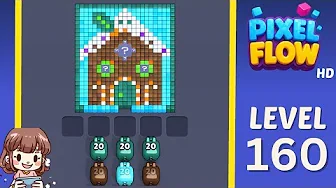
Pixel Flow Level 160 Solution & Walkthrough Guide
Struggling with Pixel Flow Level 160? This detailed walkthrough breaks down each step, offers pro tips, and helps you avoid common traps for a smooth win.
📤 Share This Level Guide
Help other Pixel Flow players by sharing this walkthrough guide!
⭐Pixel Flow Level 160 - Complete Walkthrough Guide
Level 160 in Pixel Flow throws a neat challenge your way: you need to connect 3 to 4 colored pixels to their matching endpoints on a 5x5 grid. It’s an advanced level, but the routes are pretty straightforward. The real trick? Making sure your paths don’t block each other. From my experience, this usually takes about 3 to 4 minutes once you get the hang of it.
Step-by-Step Solution
Step 1: Pattern Recognition - Start by examining the pixel placements closely. Notice the symmetry? This often hints at how the paths should flow. Spotting this early helps you visualize the solution before you even start drawing.
Step 2: Foundation Paths - Next, lay down the base paths that connect your anchor points. Think of these as the skeleton holding your whole solution together. Getting these right early prevents headaches later.
Step 3: Layer Building - Now, build the remaining paths layer by layer, working from the outside edges toward the center. Keep an eye on spacing — if paths get too close, you risk blocking routes.
Step 4: Gap Filling - With most of the main paths in place, fill in the leftover spaces by connecting the remaining pixels. Focus on maximizing the open grid space here to avoid dead ends.
Step 5: Solution Check - Finally, double-check that every colored pixel links smoothly to its matching endpoint without any breaks or overlaps. This confirms your flow is continuous and complete.
Pro Tips & Strategies
Tip 1: Outside-In Strategy - I always recommend starting from the edges and corners. These spots have fewer options, so securing their paths first makes the rest easier.
Tip 2: Color Prioritization - Tackle the colors that need the longest routes first. They demand more space, so planning these early saves you from cramming paths later.
Tip 3: Avoid Trapping - Be careful not to draw paths that completely enclose unconnected pixels. This traps them with no escape, forcing you to redo your work.
Tip 4: Use Undo Freely - Don’t be shy about undoing moves. Pixel Flow is all about trial and error, so experiment with different paths until you find the best fit.
Common Mistakes to Avoid
Trap 1: Easy First Mentality - It might feel natural to connect the simplest pixels first, but this often blocks tougher paths and makes the level harder overall.
Trap 2: Grid Center Focus - Starting from the center can backfire. The edges and corners have limited options and should be handled first.
Trap 3: Single Path Obsession - Don’t get stuck perfecting one path before moving on. Sometimes you need to adjust multiple paths together to find the right flow.
Trap 4: Ignoring Patterns - Overlooking symmetrical or repeated pixel placements slows you down. Recognizing these patterns speeds up solving.
Advanced Strategies & Mastery
Speedrun Strategy - If you’re aiming to breeze through, memorize common pixel setups and their ideal routes. Work from edges inwards, and you can finish this level in under a minute.
Minimal Moves Challenge - For a real challenge, try solving the level using the fewest moves possible—around 15 to 20. This means flawless planning and no second-guessing.
Pattern Mastery - The symmetry pattern here isn’t unique to level 160. It pops up again in levels 170, 180, and 190. Mastering it now will pay off for future puzzles.
Pro tip: Watch the video above for a visual walkthrough, then use the step-by-step guide below to replicate the solution at your own pace.
Pixel Flow AI Solver
Upload screenshot, get the next move in seconds
Drag & drop your screenshot
Or browse from your files. Supports PNG, JPG.
📤 Share This Level Guide
Help other Pixel Flow players by sharing this walkthrough guide!
⭐ Relation Levels
View All
Play Pixel Flow Now
Experience the ultimate flow puzzle game.