Pixel Flow Level 10 Solution & Walkthrough Guide
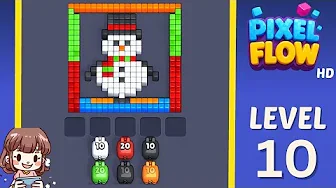
Struggling with Pixel Flow Level 10? This detailed walkthrough and guide breaks down each step to help you connect all pixels smoothly and finish fast.
📤 Share This Level Guide
Help other Pixel Flow players by sharing this walkthrough guide!
⭐Pixel Flow Level 10 - Complete Walkthrough Guide
Level 10 in Pixel Flow is a fun but tricky puzzle that really tests your ability to think spatially. You’ll be connecting 3 to 4 sets of colored pixels on a 5x5 grid. The routes look straightforward, but you need to plan carefully to avoid getting stuck. It’s a beginner-friendly level, but don’t let that fool you; a good strategy here will save you some headache. Expect to spend around 3 to 4 minutes to solve it if you take your time.
Step-by-Step Solution
Step 1: Pattern Recognition
Start by scanning the grid for any symmetrical pixel placements. This symmetry often hints at the intended paths. For example, if red pixels are placed symmetrically on opposite sides, their routes will likely mirror each other. Spotting these patterns early gives you a mental map to work from.
Step 2: Foundation Paths
Next, focus on creating foundation paths connecting the anchor points of each color. These are the key pixels you need to link first because they act as the backbone for your entire solution. Think of these paths as the frame of a picture; once they’re in place, everything else fits around them.
Step 3: Layer Building
After the foundations, build out additional paths in layers, working from the outside edges toward the center. This approach helps you keep track of open spaces and prevents routes from crossing unnecessarily. Maintaining consistent spacing between paths is crucial here, so you don’t box yourself in.
Step 4: Gap Filling
Now, fill in the remaining gaps with the last few pixel connections. Use the available space wisely by maximizing open areas, which helps avoid overlaps. This step is like putting the final pieces of a puzzle together—take your time to ensure every pixel is connected without breaking the flow.
Step 5: Solution Check
Finally, double-check your work. Make sure all colored pixels are connected continuously to their matching endpoints with no breaks or overlaps. If something feels off, retrace your paths to find where the flow might have been interrupted.
Pro Tips & Strategies
Tactical Tip 1: Edge Paths First
Start by creating paths along the edges before tackling the interior. Edges act as natural boundaries, making it easier to organize your routes and reduce complexity.
Tactical Tip 2: Color Isolation
Be careful not to isolate any color. Each color must have a clear, uninterrupted path to its endpoint. If you notice a color getting trapped, adjust your routes early to keep it connected.
Tactical Tip 3: Space Division
Mentally split the grid into sections and assign each color its own area. This tactic helps prevent colors from crossing paths and causing blockages.
Tactical Tip 4: Progressive Complexity
Start by connecting the simplest pairs first. Getting those out of the way builds confidence and frees up space for more complicated connections later on.
Common Mistakes to Avoid
Trap 1: Easy First Mentality
It might seem smart to connect the easiest pixels first, but this can backfire by blocking more challenging routes. Sometimes it’s better to tackle the tricky spots early.
Trap 2: Grid Center Focus
Don’t fixate on starting from the center of the grid. Often, working from the edges inward is more effective and less restrictive.
Trap 3: Single Path Obsession
Avoid spending too much time perfecting one path before moving on. This can stall your progress and make it harder to see the bigger picture.
Trap 4: Ignoring Patterns
Missing common pixel placement patterns slows you down. Train yourself to spot these early to speed up your solving time.
Advanced Strategies & Mastery
Meta-Strategy Development
As you get comfortable with Level 10, start developing meta-strategies that apply to other levels too. Recognizing when the same logic fits different puzzles will boost your overall gameplay.
Cognitive Optimization
Work on building a systematic approach to analyzing the grid. Breaking the puzzle down step-by-step improves your decision-making and reduces guesswork.
Cross-Level Patterns
Watch for patterns that show up in levels 15 through 25. Mastering these common layouts now will make future levels feel much more manageable and fun.
Pro tip: Watch the video above for a visual walkthrough, then use the step-by-step guide below to replicate the solution at your own pace.
Pixel Flow AI Solver
Upload screenshot, get the next move in seconds
Drag & drop your screenshot
Or browse from your files. Supports PNG, JPG.
📤 Share This Level Guide
Help other Pixel Flow players by sharing this walkthrough guide!
⭐ Relation Levels
View All
Play Pixel Flow Now
Experience the ultimate flow puzzle game.