Pixel Flow Level 806 Solution & Walkthrough Guide
Struggling with Pixel Flow level 806? This detailed walkthrough breaks down each step to help you master tight spaces and complete the level smoothly.
📤 Share This Level Guide
Help other Pixel Flow players by sharing this walkthrough guide!
⭐Pixel Flow Level 806 Solution & Walkthrough Guide
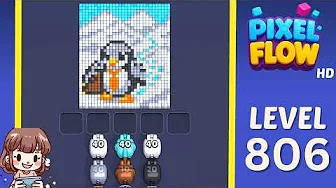
Pixel Flow level 806 is one of those levels that really tests your ability to manage tight spaces and think ahead. Here, you need to create clear, unbroken paths for every colored pixel to reach its matching endpoint. It’s a bit of a brain teaser and usually takes between 2 to 5 minutes to solve if you plan carefully.
Step 1: Map Out Pixel Density
Start by scanning the grid to see where pixels are most crowded. This helps you spot the tight spots that will give you trouble later. For example, if you notice a cluster of colors packed closely together, you’ll know that’s where you need to be extra careful.
Step 2: Prioritize High-Density Areas First
Tackle the busiest sections early on. Connecting pixels in these crowded zones first prevents bottlenecks later. Think of it like clearing traffic jams before they form. If you try to solve easy areas first, you might block the harder paths unintentionally.
Step 3: Expand into Low-Density Areas
Once the tricky spots are handled, use the leftover space to connect pixels in the less crowded parts of the grid. These areas give you more freedom, so you can connect pixels more flexibly without risking overlap.
Step 4: Balance Pixel Flow Across the Board
As you link all the colors, keep an eye on the overall distribution. You want a smooth flow where no part of the grid gets overcrowded. Balancing the density ensures each pixel has a clear route without clashes.
Step 5: Final Density Check
Before you finish, double-check that the pixel paths are well spread out and none are overlapping or blocking each other. This last look can save you from frustrating restarts.
Tip 1: Start with the Easiest Paths
Begin by connecting the simplest pixel pairs. This builds confidence and quickly clears some space, making it easier to focus on the tougher connections.
Tip 2: Reserve Space for Difficult Connections
Don’t let the easy paths gobble up all the room. Keep in mind where the tricky connections will need space and plan accordingly.
Tip 3: Approach the Grid Systematically
Work through the grid step-by-step rather than randomly connecting pixels. This methodical style prevents mistakes and helps you see the bigger picture.
Tip 4: Learn from Each Mistake
If you hit a dead end, pause and figure out why. Understanding what went wrong helps you avoid repeating the same errors and sharpens your overall strategy.
Mistake 1: Skipping Verification
Not double-checking your paths can leave hidden errors that cause failure.
Mistake 2: Partial Verification
Checking only parts of your work misses subtle overlaps or blocked pixels.
Mistake 3: Waiting Too Long to Verify
Verifying only at the very end wastes time because fixing errors then can be frustrating.
Mistake 4: False Confidence
Thinking your solution is perfect without careful review often leads to avoidable mistakes.
For a real challenge, try completing level 806 without using the undo button. This pushes your spatial reasoning skills to the max and boosts your confidence.
Also, teaching a friend how to solve this level is a great way to deepen your own understanding. Explaining your thought process forces you to clarify your strategy.
Finally, the skills you build here—careful planning, pattern recognition, and space management—will serve you well in all future Pixel Flow levels and beyond.
Pro tip: Watch the video above for a visual walkthrough, then use the step-by-step guide below to replicate the solution at your own pace.
Pixel Flow AI Solver
Upload screenshot, get the next move in seconds
Drag & drop your screenshot
Or browse from your files. Supports PNG, JPG.
📤 Share This Level Guide
Help other Pixel Flow players by sharing this walkthrough guide!
⭐ Relation Levels
View All
Play Pixel Flow Now
Experience the ultimate flow puzzle game.