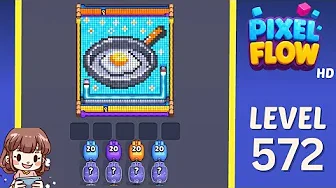
Pixel Flow Level 572 Solution & Walkthrough Guide
Struggling with Pixel Flow Level 572? This detailed walkthrough and guide breaks down every step to help you connect all pixels smoothly and efficiently.
📤 Share This Level Guide
Help other Pixel Flow players by sharing this walkthrough guide!
⭐Pixel Flow Level 572 - Complete Walkthrough Guide
Level 572 in Pixel Flow is a neat, grid-based puzzle that really tests your planning skills. The 7x7 grid is set up with symmetrical pixel placements, meaning the colored pixels and their matching endpoints are positioned evenly across the board. Your goal here is to connect each pixel to its correct endpoint by drawing paths without overlapping. It sounds simple, but the challenge is in making those connections efficiently so you don’t run out of space. From my experience, this level usually takes around 15 to 20 minutes if you take your time and plan carefully.
Step-by-Step Solution
Step 1: Grid Assessment - Before you start drawing any paths, take a good look at the entire 7x7 grid. Identify where all the pixel starting points and their matching endpoints are. This initial scan helps you spot which colors seem easiest to connect and which might be tricky. For example, if you notice a color’s endpoints are close together with a clear route, that’s a good candidate to tackle first.
Step 2: Plan Path Routes - Now, without making any moves, mentally trace potential routes for each color. Look for open corridors or straight lines that can guide your paths. This step is crucial because it prevents you from locking yourself in later. I often imagine the paths like little highways, trying to avoid any intersections or dead ends.
Step 3: Execute Priority Connections - Start by connecting pixels from the edges towards the center. This approach usually frees up the middle space for more complicated connections later. Tap on the cells one by one to draw each path carefully. Don’t rush here; making precise moves prevents having to redo paths.
Step 4: Manage Grid Space - As you build your paths, keep a close eye on the remaining empty cells. Try to keep your routes as compact as possible. Long, winding paths might look nice but can quickly eat up valuable space needed for other colors. Staying tight and efficient with your lines helps ensure all pixels can be linked without running out of room.
Step 5: Complete the Flow - Finally, finish connecting all the remaining pixels. Once done, double-check that every pixel has a complete, uninterrupted path to its matching endpoint. Sometimes, a tiny missed connection can block the whole flow, so a quick review saves frustration.
Pro Tips & Strategies
Efficiency Tip 1: Minimize Path Length - Shorter paths mean more free space for other colors. Always aim to connect pixels with the shortest possible route without cutting corners.
Efficiency Tip 2: Parallel Paths - Whenever you can, run paths parallel to each other instead of crossing. Parallel routes save space and reduce the chance of blocking other colors.
Efficiency Tip 3: Quick Assessment - Spend a few seconds at the start to judge how tricky the level looks. This helps you decide where to focus your attention and which paths to prioritize.
Efficiency Tip 4: Speed vs Accuracy - It’s tempting to rush, especially if you’re eager to finish, but rushing often causes mistakes. Taking your time to be accurate pays off by saving you from having to backtrack.
Common Mistakes to Avoid
Common Error 1: One Color Focus - Don’t get tunnel vision on a single color. If you fixate on one path, you might accidentally block the routes for others. Try to work on multiple colors incrementally.
Common Error 2: Endpoint Confusion - Make sure you’re connecting the right pixel to its matching endpoint. It’s easy to mix colors when the grid gets crowded, so double-check before you draw.
Common Error 3: Space Miscalculation - Underestimating how much space a path needs can cause trouble later on. Always count the cells you’ll need and leave room for other connections.
Common Error 4: Rigid Planning - If your initial plan isn’t working, don’t be afraid to change it. Flexibility is key, and sometimes trying a different route can make all the difference.
Advanced Strategies & Mastery
Advanced Pattern Library - As you play more levels, you’ll start recognizing common path shapes. Level 572 adds 2 to 3 important patterns to your mental toolkit, which you can reuse in future puzzles.
Instant Recognition Training - Try timed drills to boost your ability to spot patterns instantly. This practice can cut your puzzle-solving time by over half.
Pattern Variations - To truly master this level, study 5 to 7 variations of its core layout. Understanding these subtle differences prepares you for similar challenges ahead.
Pro tip: Watch the video above for a visual walkthrough, then use the step-by-step guide below to replicate the solution at your own pace.
Pixel Flow AI Solver
Upload screenshot, get the next move in seconds
Drag & drop your screenshot
Or browse from your files. Supports PNG, JPG.
📤 Share This Level Guide
Help other Pixel Flow players by sharing this walkthrough guide!
⭐ Relation Levels
View All
Play Pixel Flow Now
Experience the ultimate flow puzzle game.