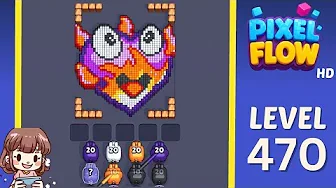
Pixel Flow Level 470 Solution & Walkthrough Guide
Struggling with Pixel Flow Level 470? This detailed guide breaks down each step, sharing pro tips and strategies to help you solve the puzzle with ease.
📤 Share This Level Guide
Help other Pixel Flow players by sharing this walkthrough guide!
⭐Pixel Flow Level 470 - Complete Walkthrough Guide
Level 470 in Pixel Flow is one of those puzzles that really tests your ability to think ahead. You’re working on a 5x5 grid, connecting 3 to 4 colored pixels. It might look simple at first, but the tricky part is managing the paths without crossing lines or getting stuck. This level demands a good mix of patience and smart planning, so expect to spend around 25 to 35 minutes working through it if you want to nail it perfectly.
Step-by-Step Solution
Step 1: Symmetry Detection – The very first thing I recommend is scanning the grid for any symmetry in how the pixels are placed. Symmetry often hints at a simpler route to solving the puzzle because it can guide how you connect the dots without backtracking. For example, if you notice pixels mirrored on opposite sides, that’s your cue to try symmetrical connections first.
Step 2: Symmetric Solving – Once you spot symmetry, start connecting pixels in a mirrored fashion. This approach reduces guesswork and keeps your paths clean. It’s like solving half the puzzle and having the other half fall into place naturally. Trust me, this saves a lot of frustration.
Step 3: Asymmetric Adjustments – However, not all connections will fit perfectly into this symmetrical pattern. At this point, you’ll need to make some tweaks—these are your asymmetric adjustments. Think of this as fine-tuning your lines to avoid overlaps or dead ends. It’s a delicate balance, and sometimes you have to backtrack a little to find the right fit.
Step 4: Balance Maintenance – While adjusting, keep an eye on the overall balance of the grid. You want your lines to flow smoothly without overcrowding one side. Maintaining spatial balance helps prevent bottlenecks and keeps the puzzle visually manageable.
Step 5: Aesthetic Verification – Finally, once all pixels are connected, take a moment to check if your solution looks neat and orderly. An aesthetically pleasing solution isn’t just about looks—it usually means your paths are efficient and well thought out, which confirms you’ve solved the puzzle correctly.
Pro Tips & Strategies
Planning Tip 1: Comprehensive Planning – Before you start dragging lines, take a good look at the entire grid. Think about where each connection might go and how they can coexist without crossing. Jumping in too fast often leads to confusion later.
Planning Tip 2: Flexible Planning – Don’t get stuck on one idea. Sometimes, the first plan won’t work out, and you’ll need to adjust on the fly. Keeping your approach flexible helps you avoid frustration when the puzzle throws a curveball.
Planning Tip 3: Layered Planning – Break down the puzzle into parts. Focus first on connecting the most obvious pairs, then move to the trickier sections. Layering your approach like this makes the whole process feel less overwhelming.
Planning Tip 4: Adaptive Planning – As you connect pixels, new constraints will appear. Stay alert and adapt your plan accordingly. This dynamic way of thinking is what separates casual players from those who really master these puzzles.
Common Mistakes to Avoid
Timing Error 1: Premature Moves – Avoid making connections before you fully understand the grid’s constraints. Rushing in often leads to having to undo moves later, which can be frustrating.
Timing Error 2: Delayed Moves – On the flip side, waiting too long to commit to a connection can cause you to lose track of your strategy or miss easy paths.
Timing Error 3: Poor Sequencing – The order in which you connect pixels matters. Connecting in a random sequence usually leads to tangled lines and dead ends. Try to find a logical flow.
Timing Error 4: Timing Inconsistency – Inconsistent pacing—sometimes rushing, sometimes hesitating—interrupts your problem-solving rhythm. Keeping a steady pace helps maintain clarity.
Advanced Strategies & Mastery
Meta-Strategy Development – Once you’ve got a handle on Level 470, start noticing how the strategies you used apply to other levels. Developing these meta-strategies makes future puzzles feel more manageable.
Cognitive Optimization – Training your brain to recognize common patterns speeds up your solving process. For example, spotting similar pixel arrangements across levels helps you predict solutions faster.
Cross-Level Patterns – Levels 475 through 485 share patterns with Level 470. Mastering these similarities will boost your confidence and save you time when facing those puzzles.
Remember, Pixel Flow is as much about patience as it is about logic. Keep practicing these steps, and you’ll find yourself breezing through Level 470 and beyond!
Pro tip: Watch the video above for a visual walkthrough, then use the step-by-step guide below to replicate the solution at your own pace.
Pixel Flow AI Solver
Upload screenshot, get the next move in seconds
Drag & drop your screenshot
Or browse from your files. Supports PNG, JPG.
📤 Share This Level Guide
Help other Pixel Flow players by sharing this walkthrough guide!
⭐ Relation Levels
View All
Play Pixel Flow Now
Experience the ultimate flow puzzle game.