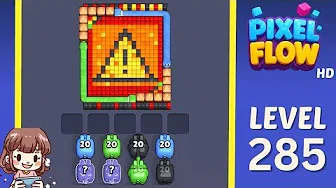
Pixel Flow Level 285 Solution & Walkthrough Guide
Struggling with Pixel Flow Level 285? This detailed walkthrough shows you how to connect all pixels on the 5x5 grid efficiently. Step-by-step tips and pro strategies included.
📤 Share This Level Guide
Help other Pixel Flow players by sharing this walkthrough guide!
⭐Pixel Flow Level 285 - Complete Walkthrough Guide
Level 285 in Pixel Flow offers a satisfying challenge on a 5x5 grid. Here, you need to connect five different colored pixel pairs without crossing paths, creating clean, continuous flows. This level steps up from earlier ones by adding more color pairs and tighter spaces, so expect to spend around 2-3 minutes carefully planning your moves. It’s a great test of your ability to juggle multiple connections while keeping an eye on the board’s layout.
Step-by-Step Solution
Step 1: Initial Survey – The first thing I do is scan the entire grid to get a clear picture of where each color’s starting point and endpoint are. Spotting all five colors and their positions helps me mentally map out potential routes. This quick overview is crucial because rushing in without knowing the layout often leads to dead ends.
Step 2: Constraint Mapping – Next, I focus on the tricky spots—the corners, edges, and especially the central squares where paths might bottleneck. Knowing these pinch points early means I can plan routes that avoid blocking future connections. For example, if a pixel sits in a corner, it usually has fewer path options, so I prioritize connecting it first.
Step 3: Priority Queue – I then create an internal priority list based on which connections are hardest or most limited by space. Typically, colors with endpoints near corners or crowded areas go at the top of this list. Tackling these first reduces the chance of trapping pixels later on.
Step 4: Systematic Execution – Now, I start drawing the flows carefully, one at a time, making sure each path leaves enough room for others. It’s tempting to rush, but a patient, step-by-step approach means fewer mistakes. For instance, if I connect the blue pixels first, I leave enough space around the center for the more complex red and green flows.
Step 5: Final Validation – Once all connections look finished, I double-check every path to confirm it’s unbroken and that no pixels are left isolated. This last step saves me from frustrating restarts caused by a missed gap or overlapping paths.
Pro Tips & Strategies
Advanced Tip 1: Endpoint Proximity – Notice which pixels are closest to their endpoints. These are usually easier to connect at the end, so I often save them for last. It feels counterintuitive, but leaving these for the final moves can make the overall puzzle smoother.
Advanced Tip 2: Path Sharing – Remember, while flows can’t cross, they can run side by side. Using parallel paths cleverly lets you fit more connections into tight spaces. For example, two colors can snake along the same row or column as long as they don’t overlap.
Advanced Tip 3: Constraint Recognition – Quickly spotting which pixels have the least freedom—often those stuck in corners or surrounded by other colors—helps prioritize your moves. These constrained pixels can easily block other paths if connected too late.
Advanced Tip 4: Solution Verification – Before you finish, give the entire board one last look to ensure every pixel connects to its endpoint without breaks. It’s frustrating to realize a path was incomplete just after finishing, so this small check saves time and stress.
Common Mistakes to Avoid
Planning Error 1: Insufficient Planning – Jumping straight into connecting pixels without surveying the board often leads to dead ends. Taking a moment to plan saves you from backtracking.
Planning Error 2: Over-Planning – On the flip side, don’t get stuck endlessly planning. At some point, you need to try paths out to see what fits.
Planning Error 3: Inflexible Plans – Sticking rigidly to your first plan can be a trap. If a route doesn’t work, be ready to adapt and try a different approach.
Planning Error 4: No Contingency – Always have a backup plan in case your initial strategy hits a snag. Sometimes a small tweak opens new possibilities.
Advanced Strategies & Mastery
Advanced Analysis – Looking deeper into this level’s spatial layout reveals patterns for the most efficient connections. For example, certain colors naturally fit better along edges, while others weave through the center.
Technique Combination – Blending careful planning with trial-and-error optimization helps you find the smoothest flows. This balance is key to mastering tougher levels.
Progression Milestone – Conquering Level 285 is a proud moment—it shows you’re ready to take on even more complex Pixel Flow challenges with confidence.
Pro tip: Watch the video above for a visual walkthrough, then use the step-by-step guide below to replicate the solution at your own pace.
Pixel Flow AI Solver
Upload screenshot, get the next move in seconds
Drag & drop your screenshot
Or browse from your files. Supports PNG, JPG.
📤 Share This Level Guide
Help other Pixel Flow players by sharing this walkthrough guide!
⭐ Relation Levels
View All
Play Pixel Flow Now
Experience the ultimate flow puzzle game.