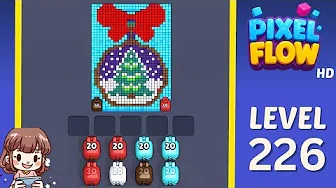
Pixel Flow Level 226 Solution & Walkthrough Guide
Struggling with Pixel Flow level 226? This detailed walkthrough breaks down step-by-step solutions and pro tips to help you master this challenging level.
📤 Share This Level Guide
Help other Pixel Flow players by sharing this walkthrough guide!
⭐Pixel Flow Level 226 - Complete Walkthrough Guide
Level 226 in Pixel Flow really tests your ability to manage tight spaces and think ahead. You’re working with a compact 6x6 grid where every move counts. The goal is to connect each colored pixel pair with unbroken paths without overlapping. It’s not just about connecting dots here; it’s about planning routes carefully to avoid blocking yourself later. From my experience, this level usually takes around 3 to 4 minutes to solve if you stay focused and patient.
Step-by-Step Solution
Step 1: Color Distribution Analysis
Start by taking a good look at how the colors are arranged on the grid. Notice if any colors are clustered together or if there’s any symmetry. This helps you figure out which paths might naturally flow together and which ones will need more space. For example, if two blue pixels are close, their path should be shorter, so you might want to prioritize colors that are farther apart first.
Step 2: Path Length Estimation
Next, estimate how long each path needs to be. Visualize the shortest possible route between each pair without crossing others. This step is crucial because it lets you allocate space wisely. Think of it like planning a city map: you want to avoid traffic jams by knowing which roads need to be longer or shorter.
Step 3: Anchor Connections
Focus on connecting the most spatially restricted pixels first. These are usually the colors squeezed into tight corners or edges. By locking in these 'anchor' connections early, you reduce the risk of cutting off space for other colors later on. Trust me, this saves a lot of backtracking.
Step 4: Progressive Completion
With your anchors in place, gradually connect the remaining colors. Keep an eye on path integrity—make sure no routes overlap or break. It’s tempting to rush here, but take your time to ensure each path is clean and doesn’t trap any other pixels.
Step 5: Grid Optimization
Finally, review the whole grid and look for small tweaks that can free up space or smooth out paths. Sometimes, shifting a single path segment can open up new possibilities elsewhere. This optimization step can be the difference between a good solution and a perfect one.
Pro Tips & Strategies
Pattern Recognition: Over time, you’ll start spotting common path shapes and shortcuts. Recognizing these patterns speeds up your solving and makes tricky sections feel more manageable.
Configuration Recognition: Certain pixel arrangements hint at specific strategies—like when two colors are diagonally opposite or when one color is completely surrounded. Learning to spot these quickly gives you a strategic edge.
Problem Recognition: Be alert to potential bottlenecks or dead ends early. Catching these issues before completing all paths saves you from frustrating restarts.
Solution Recognition: Sometimes, you just get that ‘aha’ moment where the paths fall neatly into place. Learn to trust this feeling; it often means you’re on the right track.
Common Mistakes to Avoid
Hasty Execution: Rushing moves without thinking can block critical paths and force you to undo a lot of work.
Hesitant Execution: On the flip side, second-guessing every step slows you down and can break your flow. Find a balance between careful planning and confident moves.
Imprecise Execution: Small mistakes, like slightly off paths, often snowball into bigger problems. Precision matters here.
Incomplete Execution: Avoid leaving some paths half-finished while jumping between others. It’s better to complete one path fully before moving on.
Advanced Strategies & Mastery
Ultimate Challenge: Once you’ve nailed the basic solution, try solving the level in the fewest moves possible. It’s a tough test but mastering this shows you truly understand path routing.
Teaching Others: Explaining your approach to friends or fellow players not only helps them but reinforces your own skills.
Long-term Skill: The problem-solving and spatial reasoning you develop on level 226 will serve you well in every Pixel Flow level ahead. Keep practicing, and you’ll find these techniques become second nature.
Pro tip: Watch the video above for a visual walkthrough, then use the step-by-step guide below to replicate the solution at your own pace.
Pixel Flow AI Solver
Upload screenshot, get the next move in seconds
Drag & drop your screenshot
Or browse from your files. Supports PNG, JPG.
📤 Share This Level Guide
Help other Pixel Flow players by sharing this walkthrough guide!
⭐ Relation Levels
View All
Play Pixel Flow Now
Experience the ultimate flow puzzle game.